
Side-by-Side Equipment Comparison
Compare generator outputs, detector physics, physical weights, and warranties across 2 to 4 radiography systems simultaneously.
Showing the two highest-rated systems. Add products below or use "+ Compare" on any product card.
| Feature / Parameter | ||
|---|---|---|
| Category | Digital X-Ray | X-Ray Detectors |
| Data Verification | ⚠ Sample / Demo Model Data | ⚠ Sample / Demo Model Data |
| Power Output | 80 kW High-Frequency Generator (Sample Spec) | N/A (Rechargeable Li-ion 4,800 mAh) |
| Total Weight | Ceiling bridge and carriage: 520 kg overhead structure | 2.8 kg (6.17 lbs) including battery |
| Detector / Sensor | Integrated Fixed DR | Wireless CsI Flat Panel |
| Portability | Ceiling Suspended | Handheld / Ultra-Light |
| Connectivity | Enterprise DICOM 3.0, HL7 interface, Cloud PACS gateway | Wi-Fi 6 (802.11ax) Dual-Band 2.4/5GHz + Magnetic Tether Backup |
| Main Features |
|
|
| Approx. Price | $120,000 – $180,000 (Sample Range) | $14,000 – $19,500 (Sample Range) |
| Warranty Coverage | 5-Year Comprehensive Hospital System Contract | 3-Year Drop & Liquid Ingress Manufacturer Protection |
| Manufacturer | NovaVision Healthcare Instruments GmbH | Lumina Photonics Technologies Inc. |
| Actions | Read Full Review → | Read Full Review → |
In-Depth Editorial Comparisons
Curated analysis comparing common radiography architectures and scintillator alternatives.
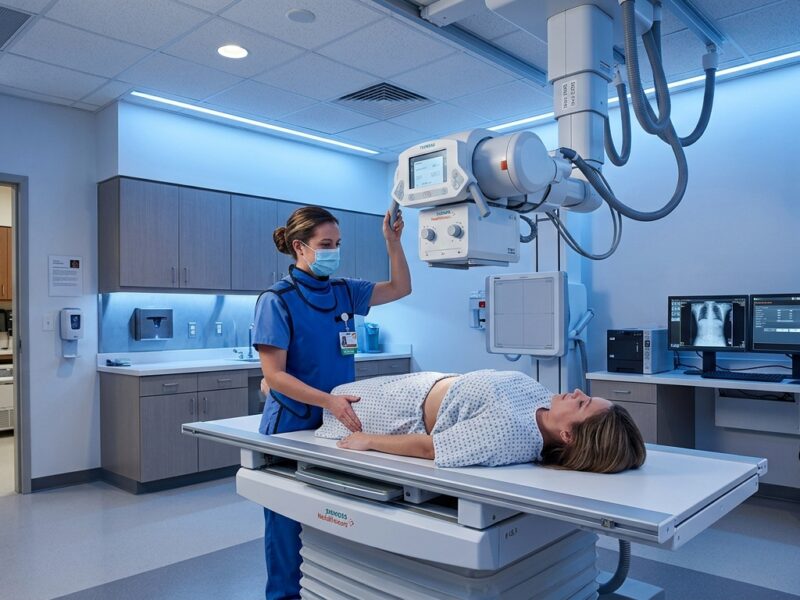
Floor-Mounted vs Ceiling-Suspended X-Ray Suites: Architectural and Clinical Comparison
Radiology directors planning a new hospital or outpatient imaging suite must decide whether to install an overhead ceiling-suspended crane system or a floor-mounted tracking rail. While ceiling-suspended suites offer total floor freedom for trauma gurneys, they entail complex structural ceiling unistrut remodeling that can double total facility costs.
Overhead Clearance: Ceiling-suspended systems eliminate floor rails, allowing medical beds, wheelchairs, and crash carts to navigate from any angle.
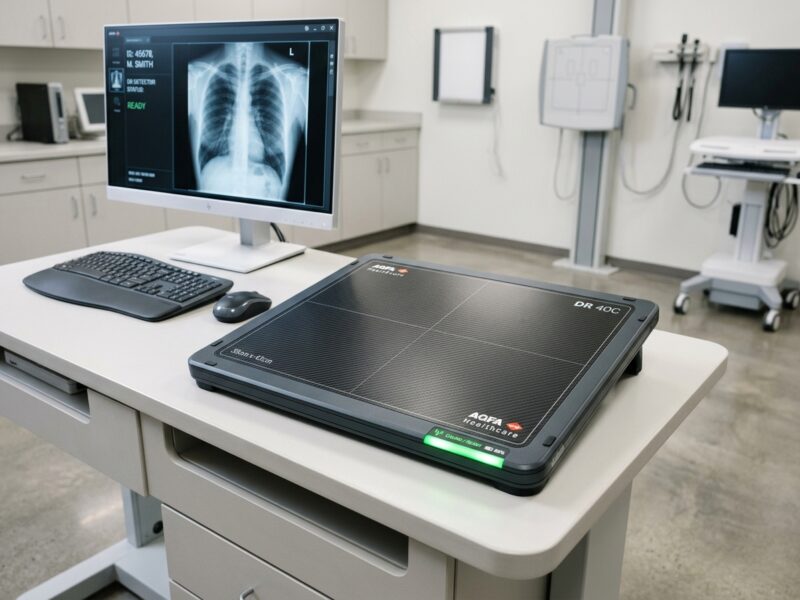
Flat Panel Detector Comparison: Cesium Iodide (CsI) vs GadOx Scintillators
When shopping for digital radiography flat panel detectors, buyers are immediately confronted with two primary scintillator materials: Cesium Iodide (CsI:Tl) and Gadolinium Oxysulfide (Gd2O2S:Tb, commonly known as GadOx or GOS). Understanding the physical differences in light piping, quantum efficiency, and radiation dose is crucial for making an informed capital decision.
Crystal Structure: CsI is grown in vertically aligned needle-like crystals that act as light pipes, channeling scintillation light directly down to the photodiode with minimal lateral scatter.
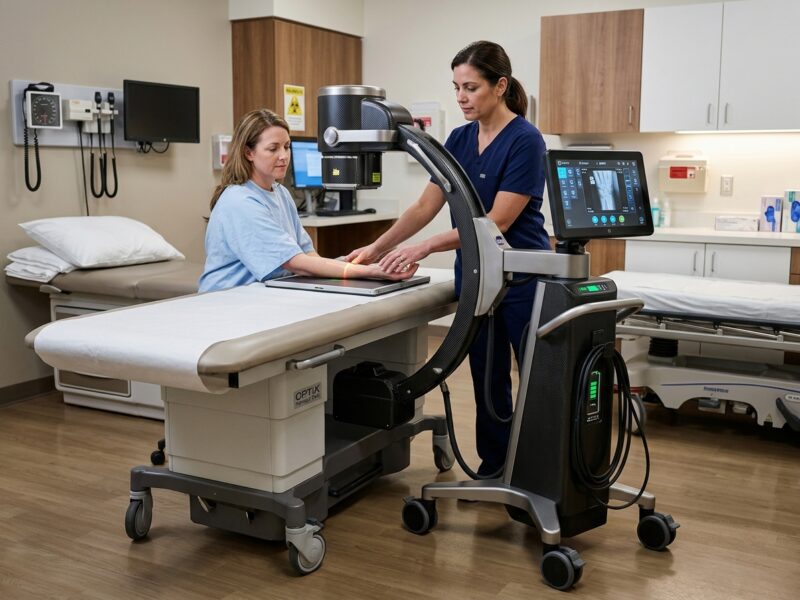
Best Portable X-Ray Machines: In-Depth Comparison of Field Radiography Units
Portable radiography units must survive punishing field conditions, transport in vehicle trunks, and unpredictable clinic environments while maintaining exposure reproducibility. In this comprehensive head-to-head comparison, we evaluate three representative portable systems across generator power, ergonomics, battery endurance, and software usability.
Weight matters most for solo technologists: Units under 8 kg cause substantially less muscle strain over multiple daily patient visits.
Digital Radiography (DR) vs Computed Radiography (CR): The True Efficiency Analysis
Computed Radiography (CR) was a critical stepping stone in the digital transition, replacing chemical wet film with reusable photostimulable phosphor (PSP) cassettes. However, with modern flat panel digital radiography (DR) detectors dropping in price, the operational costs, labor overhead, and mechanical maintenance of CR laser readers have made DR the indisputable gold standard.
Image Acquisition Speed: DR produces full diagnostic previews in 2–3 seconds; CR requires 60–90 seconds per plate to carry to the laser scanner and erase.
Portable vs Fixed X-Ray Machines: Clinical Capabilities, Power, and Facility Fit
Choosing between a portable X-ray unit and a fixed radiographic room suite is one of the most critical capital expenditure decisions for new clinics and expanding facilities. While portable units offer unparalleled mobility and lower upfront purchase prices, fixed suites provide immense generator output (50 kW to 80 kW) that is physically impossible to pack into a lightweight mobile chassis.
Generator Power Gap: Portable units typically operate between 1.5 kW and 4.0 kW, whereas fixed room suites produce 50 kW to 80 kW.