
Digital Radiography (DR) vs Computed Radiography (CR): The True Efficiency Analysis
Why medical and veterinary practices are retiring phosphor storage plates (PSP) for instant flat panel detectors.

Key Engineering Takeaways & Summary
- •Image Acquisition Speed: DR produces full diagnostic previews in 2–3 seconds; CR requires 60–90 seconds per plate to carry to the laser scanner and erase.
- •Radiation Dose (ALARA): Modern CsI flat panels deliver equal or better image contrast with 30% to 50% less radiation dose than standard CR plates.
- •Mechanical Maintenance: CR digitizers possess precision moving mirrors, rollers, and lasers prone to dust contamination and jamming; solid-state DR panels eliminate moving parts.
- •Technologist Workflow: Technologists remain at the patient bedside with DR rather than walking back and forth to an external plate digitizer.
Comparison Overview
Computed Radiography (CR) was a critical stepping stone in the digital transition, replacing chemical wet film with reusable photostimulable phosphor (PSP) cassettes. However, with modern flat panel digital radiography (DR) detectors dropping in price, the operational costs, labor overhead, and mechanical maintenance of CR laser readers have made DR the indisputable gold standard.
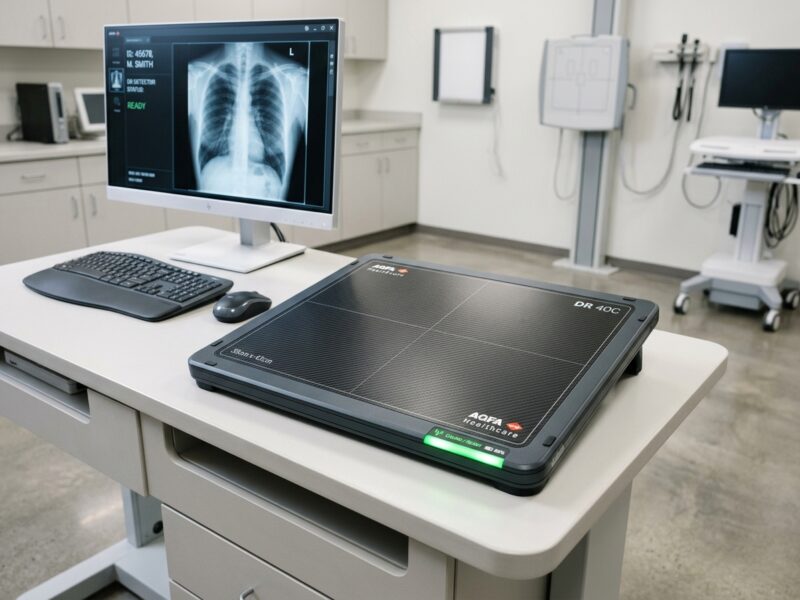
Lumina 1417-CsI Wireless DR Panel
A direct-deposit Cesium Iodide (CsI) wireless flat panel detector engineered for cassette-tray retrofit upgrades and low-dose clinical imaging.
QuantumDirect 1417 GadOx Retrofit FPD
A value-engineered Gadolinium Oxysulfide (GadOx / GOS) flat panel detector offering an affordable direct DR upgrade path for budget-constrained private practices.
The 90-Second Walk: Hidden Labor Costs of CR
In a clinic performing 30 multi-view exams per day (averaging 3 views each), technologists expose 90 cassettes. With CR, each cassette must be carried to a centralized digitizer, manually inserted, scanned, erased, and retrieved. This adds between 60 to 90 minutes of unproductive walking and scanning time per technologist per shift. Direct DR displays images on the acquisition monitor before the technologist even steps away from the control console.
Detective Quantum Efficiency (DQE) and Dose Reduction
Standard barium fluorohalide CR plates exhibit a DQE of approximately 25% to 30% at zero spatial frequency. Modern Cesium Iodide (CsI) direct-deposit flat panel detectors routinely achieve DQE ratings exceeding 70%. In clinical terms, a CsI DR panel converts incoming X-ray photons into usable signal with more than double the optical efficiency, allowing clinics to safely cut patient radiation doses.
Best Suited For: Clinical Recommendations
Any active clinic still using CR laser plate digitizers
Immediate 3-second workflow, substantial dose reduction, and zero generator rewiring via AED.
Extreme low-budget private offices replacing broken CR
Lowest cost entry into direct DR imaging under $12,000.
Editorial Verdict
Continuing to purchase replacement CR plates or paying high annual maintenance contracts on aging CR laser digitizers is no longer economically sound. A wireless flat panel detector with AED retrofits directly into existing equipment, paying for itself in technologist labor savings and patient satisfaction.