Flat Panel Detector Comparison: Cesium Iodide (CsI) vs GadOx Scintillators
Understanding the physics, Detective Quantum Efficiency (DQE), image resolution, and cost difference between detector types.

Key Engineering Takeaways & Summary
- •Crystal Structure: CsI is grown in vertically aligned needle-like crystals that act as light pipes, channeling scintillation light directly down to the photodiode with minimal lateral scatter.
- •Turbid Phosphor: GadOx is a turbid (powdered) phosphor where light scatters in all directions, causing optical blurring unless the layer is kept thin (which reduces absorption efficiency).
- •Detective Quantum Efficiency (DQE): CsI achieves ~70% to 75% DQE at 0 lp/mm; GadOx typically achieves ~45% to 50%.
- •Price Gap: GadOx detectors generally cost $3,000 to $6,000 less than equivalent CsI panels, making them tempting for low-budget clinics.
Comparison Overview
When shopping for digital radiography flat panel detectors, buyers are immediately confronted with two primary scintillator materials: Cesium Iodide (CsI:Tl) and Gadolinium Oxysulfide (Gd2O2S:Tb, commonly known as GadOx or GOS). Understanding the physical differences in light piping, quantum efficiency, and radiation dose is crucial for making an informed capital decision.
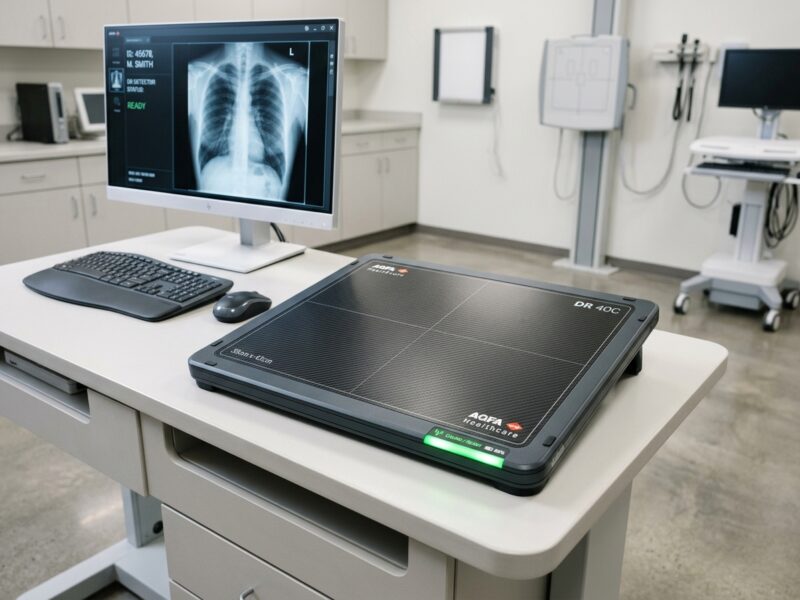
Lumina 1417-CsI Wireless DR Panel
A direct-deposit Cesium Iodide (CsI) wireless flat panel detector engineered for cassette-tray retrofit upgrades and low-dose clinical imaging.
QuantumDirect 1417 GadOx Retrofit FPD
A value-engineered Gadolinium Oxysulfide (GadOx / GOS) flat panel detector offering an affordable direct DR upgrade path for budget-constrained private practices.
VisiRay 1717-DR High-DQE Flat Panel
A full-format 17x17 inch wireless Cesium Iodide flat panel detector that eliminates the need to rotate cassettes between portrait and landscape chest exams.
The Optical Physics of Needle-Structure CsI
When an incoming X-ray photon strikes the scintillator, it is converted into visible light photons. In a powder GadOx layer, that light spreads outward like headlights in fog, blurring fine edges before reaching the amorphous silicon photodiode. In contrast, needle-grown CsI confines light within columnar fibers 5 to 10 microns wide. This allows manufacturers to make the CsI layer significantly thicker (absorbing more X-rays) without sacrificing spatial sharpness.
Clinical Dose Implications (ALARA)
Because CsI absorbs and converts photons with substantially higher efficiency, clinical exposure parameters (mAs) can be reduced by 30% to 50% compared to GadOx while achieving identical image signal-to-noise ratio (SNR). For pediatric practices, orthopedic centers monitoring scoliosis curves, and high-volume facilities, CsI is the only medically responsible choice.
Best Suited For: Clinical Recommendations
Pediatric, Orthopedic & High-Volume Radiology
Superior DQE and significant patient dose reduction (ALARA compliance).
Low-Volume Private Practice & Secondary Backup
Affordable entry price under $12,000 for clinics performing fewer than 10 exams per day.
Editorial Verdict
While GadOx remains a viable budget option for low-volume extremity or chiropractic clinics, Cesium Iodide (CsI) has become the gold standard for clinical radiography due to its superior Detective Quantum Efficiency and lower patient radiation dose.